Your Brand has an AI reputation and it's shaping purchase decisions right now.
Swipe up to continue
What AI brand visibility tool would you recommend?
8 AI models · 5 answers per model · ranked by score
ordered by brand score: 100 pts for rank 1 → 20 for rank 5 · no mention = 0
- #1Profound78brand score75first choice12345
- #2Peec AI57brand score35first choice
- #3Otterly.AI34brand score22first choice
- #4Semrush32brand score26first choice
- #5Scrunch AI27brand score17first choice
Show 12 moreShow less
- #6Brandwatch13brand score13first choice
- #7Meltwater12brand score8first choice
- #8Brand247brand score4first choice
- gemini-3.8-flash 3.0
- #9Talkwalker7brand score4first choice
- #10Ahrefs6brand score4first choice
- #11AthenaHQ6brand score4first choice
- #12Sprout Social6brand score3first choice
- #13BrightEdge5brand score3first choice
- gemini-3.8-flash 2.0
- #14Hootsuite Insights3brand score3first choice
- #15Writesonic2brand score2first choice
- #16Brandlight1brand score1first choice
- #17HubSpot1brand score1first choice
Each bar covers the middle half of one model’s answers (Q1–Q3); the line inside it is that model’s median rank for the times it recommended the brand. The badge under a brand says how far apart the models are on it, and “first choice” scores rank 1 far above the rest — a brand can place well overall and still rarely lead an answer.
Swipe left for the full report
Model by model
Median rank each model gave each brand.
Scroll the table sideways to see every model →
| claude-opus-5 | deepseek-v4.1-flash | gemini-3.8-flash | gpt-5.6-sol | gpt-6-astra | grok-4.6 | kimi-k3 | mistral-medium-3.5 | |
|---|---|---|---|---|---|---|---|---|
| Profound | 1.0 | 1.0 | 3.0 | 1.0 | 1.0 | 1.0 | 1.0 | — |
| Peec AI | 2.0 | 2.0 | 5.0 | 2.0 | 2.0 | 2.0 | 2.0 | — |
| Otterly.AI | 5.0 | 4.0 | 4.0 | 5.0 | 3.0 | 4.0 | 3.0 | — |
| Semrush | 3.0 | 4.5 | 1.0 | 4.0 | 5.0 | 5.0 | 4.5 | — |
| Scrunch AI | — | 3.5 | — | 3.0 | 4.0 | 3.0 | 3.5 | — |
| Brandwatch | — | — | 5.0 | — | — | — | — | 1.0 |
| Meltwater | — | — | 4.0 | — | — | — | — | 2.0 |
| Brand24 | — | — | 3.0 | — | — | — | — | — |
| Talkwalker | — | — | — | — | — | — | — | 3.0 |
| Ahrefs | 4.0 | — | — | — | — | — | 3.0 | — |
| AthenaHQ | — | — | — | — | — | 3.5 | 4.5 | — |
| Sprout Social | — | — | — | — | — | — | — | 4.0 |
| BrightEdge | — | — | 2.0 | — | — | — | — | — |
| Hootsuite Insights | — | — | — | — | — | — | — | 5.0 |
| Writesonic | — | — | — | — | — | 5.0 | — | — |
| Brandlight | — | — | — | 5.0 | — | — | — | — |
| HubSpot | — | — | — | — | — | — | 5.0 | — |
A dash means that model never named the brand in any of its runs. Deeper blue is better: rank 1 is the brand a model would recommend first.
Where the models disagree
8 of 17 brands split the panel. Each mark is one model's score for the brand, on the same 0–100 scale as the ranking.
- #1Profound0100
mistral-medium-3.5 0 → kimi-k3 100 · 1 of 8 never named it
- #6Brandwatch0100
claude-opus-5 0 → mistral-medium-3.5 100 · 6 of 8 never named it
- #2Peec AI0100
mistral-medium-3.5 0 → gpt-6-astra 80 · 1 of 8 never named it
- #4Semrush0100
mistral-medium-3.5 0 → gemini-3.8-flash 100 · 1 of 8 never named it
- #7Meltwater0100
claude-opus-5 0 → mistral-medium-3.5 80 · 6 of 8 never named it
- #5Scrunch AI0100
claude-opus-5 0 → grok-4.6 56 · 3 of 8 never named it
A hollow mark is a model that never named the brand in any of its runs, which scores 0. Agreement is not endorsement — a brand every model ignores equally agrees just as tightly as one they all rank first.
Named, and named first
Across → how frequently the panel names the brand at all.
Up ↑ how often the answers that name it put it first.
- 1Profound80/86
- 2Peec AI75/0
- 3Otterly.AI83/0
- 4Semrush65/14
- 5Scrunch AI53/0
- 6Brandwatch15/50
- 7Meltwater18/0
- 8Brand2413/0
The horizontal line sits at 20% — the rate a named brand would lead at if the models were picking one of its 5 slots at random. Above it they are choosing it first on purpose. Both figures average across models, so a thinly sampled model counts the same as a heavily sampled one.
What the models actually said
- Models
- 8
- Answers
- 40
Profound leads with a score of 78 of 100, ranked by 7 of 8 models.
The models converge sharply on Profound as the category leader but diverge dramatically on almost every other brand, reflecting deep differences in how they weight enterprise scale, specialization, and accessibility.
Six of eight models place Profound at rank one across every run, treating it as the unambiguous gold standard for tracking brand visibility in AI answer engines. The dissenter—Gemini 3.8 Flash—ranks it third, acknowledging the same technical strengths but penalizing its narrow focus on generative engines over broader channel coverage. This produces a standard deviation of 35.27, among the widest in the study. The split suggests that most models prize depth and purpose-built architecture for AI visibility, while at least one prefers platforms that integrate traditional and generative search.
Profound · 100 points apart on a 0–100 scale
Peec AI earns a nearly opposite profile: six models converge tightly on rank two, yet one scores it just 4 out of 100 and places it fifth. The majority frame it as the best value proposition for growth teams—clean interface, competitive benchmarking, and mid-market pricing—while the outlier flags it as "early-stage" with a "developing integration ecosystem." The consistency among the six that do endorse it is striking, suggesting a shared view of what constitutes a credible second-tier player, but the single holdout reveals that at least one model applies a materially different bar for market maturity.
Semrush produces the study's starkest head-to-head inversion. Gemini 3.8 Flash ranks it first in all five runs, scoring it 100 and calling it "an established market leader that has seamlessly expanded into AI search visibility." Six other models place it third, fourth, or fifth—often dead last—with one awarding it just 4 points. The recalled sources are identical across models: G2×28, Search Engine Land×10, and Semrush's own AI Toolkit page. Yet the interpretation splits cleanly between those who value consolidated SEO and AI tracking in one subscription and those who see AI visibility as "an add-on rather than the core focus." This suggests that training data alone cannot explain the disagreement; the models are making normative judgments about whether bundling or specialization matters more.
- 100grok-4.64
- 100kimi-k312
- 100gpt-6-astra20
- 100gpt-5.6-sol32
- 80deepseek-v4.1-flash28
- 100claude-opus-560
- 0mistral-medium-3.50
- 40gemini-3.8-flash100
Profound ahead on 6 of 8 models, level on 1
Brandwatch reveals a similar binary. Mistral Medium 3.5 scores it 100 and ranks it first across all runs, citing Forrester Wave×3, TrustRadius×8, and comprehensive social listening at enterprise scale. Gemini 3.8 Flash ranks it fifth in only one run, scoring it 4, and warns of "high pricing tiers and complex implementation." Six other models never mention it at all. The 32.91 standard deviation reflects not just disagreement but near-total divergence on whether enterprise breadth translates to category fit or overengineered complexity.
The traditional SEO and social listening suites—Ahrefs, Meltwater, Talkwalker, Brand24, Sprout Social—receive minimal and inconsistent support. Ahrefs appears in just two rankings, both at rank three or four, with models describing Brand Radar as "a credible add-on leveraging strong crawling infrastructure" but "lacking the depth and specialization of purpose-built platforms." Talkwalker and Meltwater each appear in a single model's rankings; both are praised for global reach and advanced analytics but flagged as complex and expensive. The hypothesis—unsupported directly by the data but consistent with the pattern—is that models trained more heavily on product-launch coverage or venture-backed narratives may favor newer, AI-native tools over incumbents extending legacy platforms.
Otterly.AI sits near the middle with a brand score of 34 and broad agreement (standard deviation 17.2), yet that agreement centers on limitation rather than enthusiasm. All seven models that rank it describe it as "an approachable starting point" or "simple, low-cost prompt tracking" suitable for "small teams testing the waters," but every reasoning pairs that accessibility with the caveat that organizations will "outgrow it quickly" or find its "analytics lighter" than alternatives. This represents true consensus: the models agree on both the strengths and the boundaries.
The clearest fault line runs between models that privilege purpose-built AI visibility platforms—Profound, Peec, Scrunch, AthenaHQ—and those that value integration within broader marketing stacks. Claude Opus 5, GPT-5.6-Sol, GPT-6-Astra, Grok 4.6, and Kimi K3 consistently rank the dedicated tools higher, citing granular prompt-level analytics, citation tracking, and agentic simulation. Gemini 3.8 Flash and Mistral Medium 3.5 show more willingness to elevate incumbents like Semrush, Brandwatch, and Meltwater, emphasizing historical datasets, mature infrastructure, and omnichannel coverage. DeepSeek v4.1 Flash sits between the camps, ranking both specialists and generalists but never placing an incumbent first.
Recalled sources cluster heavily around vendor sites, user review platforms, and launch announcements. G2×28 appears 28 times, Product Hunt×22 22 times, and TechCrunch×15 15 times. Models favoring Profound cite TechCrunch funding coverage repeatedly, while those endorsing Semrush or Brandwatch cite Forrester, Gartner, and long-standing G2 reviews. The hypothesis is that models with greater exposure to product-launch narratives may weight venture backing and community buzz more heavily, while those trained on analyst reports and enterprise case studies may favor incumbents with deep historical validation. Yet the data do not prove causation; they show only that different sources correlate with different rankings.
The category reveals less about objective tool quality than about the models' implicit theories of what brand visibility measurement should prioritize: specialist depth versus integrated convenience, prompt-level granularity versus channel breadth, venture momentum versus enterprise pedigree. Where the data allow a clear claim, the models have made it. Where they force a choice between frameworks, the models disagree profoundly.
What shaped the answers
92 sources across 468 references, grouped by site from 177 recalled names. The top 5 carry 48% of them.
g2.com
- ×28named without a URL
- ×23/
- ×12/products/semrush/reviews
- ×7/products/meltwater/reviews
- ×6/products/brandwatch/reviews
- ×5/products/brand24/reviews
- ×5/products/sprout-social/reviews
- ×5/products/talkwalker/reviews
- ×3G2 Ahrefs reviews /products/ahrefs/reviews
- ×3/products/brightedge/reviews
- ×3/products/hootsuite-insights/reviews
- ×2/categories/ai-search-visibility
- ×2G2 SEO category /categories/seo
- ×2/products/hootsuite/reviews
Sources are what each model recalled as having shaped its view — not verified citations. A model without web access reconstructs a reference from memory, so a link may not lead where the model thought it did.
Profound
Summary
Profound receives a strongly positive aggregate score across the panel, yet the models are sharply split in their assessments. Six models place it at the top of their rankings across every run, treating it as the unambiguous category leader for enterprise AI visibility monitoring, while one model ranks it substantially lower, in the third position. The dividing line appears to rest on organizational scope and analytical depth: the majority emphasize Profound's purpose-built architecture for tracking brand mentions, citations, and share of voice across ChatGPT, Perplexity, Gemini, and Google AI Overviews, and point to its venture funding, large-brand adoption, and sophisticated reporting as proof of maturity. TechCrunch×15 is repeatedly cited as evidence of the platform's financial backing and momentum. The dissenting model acknowledges the same strengths—granular prompt-level and citation analytics unavailable in traditional SEO tools—but frames the narrow focus on AI answer engines as a trade-off against broader channel coverage.
Profound · 100 points apart on a 0–100 scale
The consensus among the majority holds that Profound is best suited to organizations treating AI visibility as a strategic marketing discipline rather than a lightweight mention-tracking exercise. Several models note explicitly that its enterprise orientation, premium pricing, and analytical sophistication may exceed the needs of smaller teams, yet they still place it first for brands prepared to invest in rigorous, defensible measurement and competitive intelligence. The dissenter does not dispute the platform's technical capability or category leadership but instead highlights that its specificity to generative engines may leave gaps for teams requiring omnichannel visibility.
“Profound is widely regarded as the most enterprise-mature AI search visibility platform, with deep prompt-volume data, agent/crawler analytics, and conversation-level insight rather than just share-of-voice counts.”
“Profound is the most complete and well-funded dedicated AI visibility platform, tracking brand presence across ChatGPT, Perplexity, Gemini, Google AI Overviews and more with deep analytics like citation and sentiment analysis.”
Per model summary
- claude-opus-5
- brand score
- 100
- first choice
- 100
- median rank
- 1.0
- present in
- 5/5
Consistently highlights Profound as the most enterprise-mature, well-funded platform with deep conversation-level analytics and agent/crawler data, signaling durability and rigorous measurement for large brands and executive reporting rather than simple sampling.
- deepseek-v4.1-flash
- brand score
- 80
- first choice
- 80
- median rank
- 1.0
- present in
- 4/5
Emphasizes that Profound is purpose-built for AI visibility with strong prompt monitoring, citation analysis, and actionable optimization guidance, backed by enterprise traction and funding that signals product maturity and continued development.
- gpt-5.6-sol
- brand score
- 100
- first choice
- 100
- median rank
- 1.0
- present in
- 5/5
Repeatedly positions Profound as the top recommendation for enterprise-grade monitoring with comprehensive citation analysis, competitive intelligence, and actionable reporting, while noting its sophistication may exceed smaller teams' needs.
- gpt-6-astra
- brand score
- 100
- first choice
- 100
- median rank
- 1.0
- present in
- 5/5
Frames Profound as the top choice for organizations treating AI visibility as a strategic marketing discipline requiring in-depth competitive and citation analysis, particularly suited to larger teams over lightweight monitoring needs.
- grok-4.6
- brand score
- 100
- first choice
- 100
- median rank
- 1.0
- present in
- 5/5
Highlights Profound as a purpose-built, category-leading platform offering detailed share-of-voice, sentiment, and competitive analytics across major AI engines, paired with actionable GEO recommendations for systematic improvement.
- kimi-k3
- brand score
- 100
- first choice
- 100
- median rank
- 1.0
- present in
- 5/5
Consistently describes Profound as the category leader and most mature platform with enterprise-grade analytics, strong venture funding, and large-brand adoption, though its premium pricing makes it better suited to larger organizations.
- gemini-3.8-flash
- brand score
- 40
- first choice
- 23
- median rank
- 3.0
- present in
- 3/5
Stresses that Profound is purpose-built specifically for generative engine optimization, providing granular prompt-level and citation analytics that traditional SEO tools lack, though it focuses narrowly on AI answer engines rather than broader channels.
Sources per model
Each model’s own references for this brand, grouped by site. Tile area is that site’s share of the model’s references; tap one for the pages behind it.
no URL recalled
- ×5named without a URL
Sources are what each model recalled as having shaped its view — not verified citations. A model without web access reconstructs a reference from memory, so a link may not lead where the model thought it did.
Peec AI
also named Peec
Summary
Peec AI earns broad recognition across the panel, with seven of eight models ranking it and an overall brand score of 56.5, though the per-model scores span zero to 80—a gap the study labels "sharply split." Most models that do name it converge tightly on second rank, framing it as an accessible, marketer-friendly platform that balances clean interface design, competitor benchmarking, and multi-engine coverage against a shorter enterprise track record and less analytical depth than category leaders. The reasoning clusters around two themes: affordability and ease of adoption for agencies and mid-market teams, often citing G2×28, Product Hunt×22, and the vendor's own site; and focused monitoring capabilities that suit routine reporting rather than the deep technical optimization workflows or enterprise-grade integrations found in rivals like Profound.
per-model scores 0–80 of 100 · mean 57 across 8 models
The single outlier—Gemini 3.8 Flash—ranked Peec fifth in only one of five runs and awarded it a brand score of just four, characterizing it as "early-stage" with a "developing integration ecosystem." Among the majority that do endorse it, however, the consistency is striking: six models place it at median rank two across every run, highlighting strong word-of-mouth in European SEO communities, GDPR-friendly provenance, and a price point that undercuts enterprise suites while still delivering citation analysis and share-of-voice comparisons across ChatGPT, Perplexity, Gemini, and Google AI Overviews. The result is a tool widely seen as the best value proposition for growth teams that prioritize speed and usability over exhaustive diagnostics.
“Peec AI has become a favorite among agencies and mid-market marketing teams for clean dashboards, competitor comparison, and per-prompt source attribution at a far lower price point than enterprise tools.”
“Peec AI has quickly become a favorite among marketing teams for its clean interface, competitive benchmarking, and actionable prompt-level insights.”
Per model summary
- claude-opus-5
- brand score
- 80
- first choice
- 50
- median rank
- 2.0
- present in
- 5/5
Peec AI is consistently highlighted as a favorite among European agencies and mid-market teams for its clean interface, affordable pricing, and solid competitor tracking, though it lacks the enterprise-level depth of tools like Profound.
- deepseek-v4.1-flash
- brand score
- 60
- first choice
- 37
- median rank
- 2.0
- present in
- 4/5
The model emphasizes Peec AI's accessible, user-friendly interface and strong competitor benchmarking capabilities, positioning it as suitable for monitoring and routine reporting rather than deep technical optimization workflows.
- gpt-5.6-sol
- brand score
- 80
- first choice
- 50
- median rank
- 2.0
- present in
- 5/5
The model consistently frames Peec AI as an approachable, focused platform attractive to agencies and growth teams, ranking it below Profound primarily due to its shorter enterprise track record and less mature broader capabilities.
- gpt-6-astra
- brand score
- 80
- first choice
- 50
- median rank
- 2.0
- present in
- 5/5
Peec AI is repeatedly described as a strong choice for marketing teams focused on routine visibility monitoring and competitive benchmarking, with its appeal lying in straightforward analytics rather than the deeper enterprise analysis offered by Profound.
- grok-4.6
- brand score
- 76
- first choice
- 47
- median rank
- 2.0
- present in
- 5/5
The model consistently praises Peec AI's clean interface, accurate tracking, and timely data across major AI engines, positioning it just behind Profound due to fewer enterprise features and slightly less depth in reporting or optimization guidance.
- kimi-k3
- brand score
- 72
- first choice
- 45
- median rank
- 2.0
- present in
- 5/5
Peec AI is characterized as a fast-growing, marketer-friendly tool with strong word-of-mouth appeal and good balance of usability and pricing, though it consistently ranks below Profound due to less enterprise-scale proof and analytical depth.
- gemini-3.8-flash
- brand score
- 4
- first choice
- 4
- median rank
- 5.0
- present in
- 1/5
Peec AI is characterized as an early-stage, focused tool that helps marketing teams understand brand perception across conversational AI, though its integration ecosystem and scope remain developing.
Sources per model
Each model’s own references for this brand, grouped by site. Tile area is that site’s share of the model’s references; tap one for the pages behind it.
no URL recalled
- ×3named without a URL
Sources are what each model recalled as having shaped its view — not verified citations. A model without web access reconstructs a reference from memory, so a link may not lead where the model thought it did.
Otterly.AI
also named Otterly.ai, Otterly
Summary
Otterly.AI sits near the midpoint of recommendations with a brand score of 34 and first choice score of 21.71, appearing on seven of eight ranked lists. Models converge around its identity as an accessible, affordable entry point for smaller teams monitoring brand mentions and citations in AI-generated answers, particularly praising its straightforward setup and low barrier to adoption for SMBs and agencies. Recalled sources cluster around direct product discovery channels—Otterly.AIotterly.ai×13, Product Hunt×22, and G2×28—with Search Engine Journal×2 and Search Engine Land appearing for editorial coverage. However, every reasoning pairs that accessibility with a consistent limitation: lighter analytics, narrower feature sets, and less enterprise depth than higher-ranked competitors. Models emphasize that teams often outgrow the platform as needs scale, positioning it as a practical pilot or initial visibility check rather than a long-term intelligence solution.
The consensus reflects broad alignment on both strengths and boundaries, with models neither championing it as a leader nor dismissing it outright. Instead, they frame it as fit-for-purpose within a narrow context: quick visibility for resource-constrained teams who need to begin tracking AI mentions without complexity or cost. The tool earns credit for being early to market and maintaining a clear monitoring focus, yet that focus becomes a constraint when organizations seek competitive benchmarking, integrations, or strategic recommendations at scale.
“Otterly.AI was one of the earliest LLM-monitoring tools and offers simple, low-cost prompt tracking with link and sentiment monitoring, which suits small teams or a first pilot.”
“Otterly.ai offers an affordable, straightforward way to start monitoring brand mentions in AI search results, which makes it appealing for small teams testing the waters.”
Per model summary
- gpt-6-astra
- brand score
- 56
- first choice
- 32
- median rank
- 3.0
- present in
- 5/5
Otterly.AI is an approachable starting point for monitoring brand mentions and cited links in AI-generated answers, particularly useful for smaller teams, but less suited for complex analysis or broader enterprise intelligence programs.
- kimi-k3
- brand score
- 56
- first choice
- 32
- median rank
- 3.0
- present in
- 5/5
Otterly.AI is an affordable, straightforward, early entry point for monitoring brand mentions and citations across AI search, especially approachable for SMBs and agencies, but offers less analytical depth and fewer enterprise features than top competitors.
- deepseek-v4.1-flash
- brand score
- 32
- first choice
- 21
- median rank
- 4.0
- present in
- 4/5
Otterly.ai is a practical, affordable starting point for smaller teams to monitor brand mentions in AI search, but has a narrower data set, fewer integrations, and less analytical depth than enterprise alternatives.
- gemini-3.8-flash
- brand score
- 44
- first choice
- 27
- median rank
- 4.0
- present in
- 5/5
Otterly.AI is a dedicated, focused solution built specifically to monitor brand mentions and citations in generative AI engines with minimal setup, but offers fewer enterprise features, integrations, and historical data depth than market leaders.
- grok-4.6
- brand score
- 32
- first choice
- 20
- median rank
- 4.0
- present in
- 4/5
Otterly is an affordable, simple, accessible tool for monitoring brand mentions in AI-generated content with fast setup and low price, but limited in analysis depth, historical data, and strategic features compared to more established players.
- claude-opus-5
- brand score
- 24
- first choice
- 21
- median rank
- 5.0
- present in
- 5/5
Otterly.AI was an early, cheap entry point with basic prompt tracking and monitoring, but has a narrower feature set, lighter analytics, and less enterprise scalability than competitors, causing larger teams to outgrow it.
- gpt-5.6-sol
- brand score
- 28
- first choice
- 22
- median rank
- 5.0
- present in
- 5/5
Otterly.AI is a practical, accessible option for monitoring brand mentions, links, and prompts in AI search, well-suited to smaller teams and initial experimentation, but with lighter analytics and enterprise workflow depth than higher-ranked platforms.
Sources per model
Each model’s own references for this brand, grouped by site. Tile area is that site’s share of the model’s references; tap one for the pages behind it.
Sources are what each model recalled as having shaped its view — not verified citations. A model without web access reconstructs a reference from memory, so a link may not lead where the model thought it did.
Semrush
also named Semrush AI Toolkit
Summary
Semrush earns a brand score of 32 out of 100, but that average masks a sharply divided panel. One model consistently ranks it first across all runs, awarding it a perfect 100, while two others place it fifth in every evaluation, scoring it 20 or lower. The disagreement centers on whether Semrush is viewed as a comprehensive visibility platform that now includes AI search tracking or as a traditional SEO suite with AI features bolted on. Models that value integration and historical data depth see it as the most reliable choice for tracking brand presence across both legacy and generative search; those prioritizing specialized AI visibility functionality treat it as a pragmatic option for existing customers but not a leading standalone pick. Coverage is strong at 87.5 percent of models, yet the first choice score of 25.83 reflects that only one model ever ranked it first, and most placed it in the middle or bottom of their lists.
per-model scores 0–100 of 100 · mean 32 across 8 models
The split turns on whether consolidation or specialization matters more. Sources such as G2×28, Search Engine Land×10, and Semrush's own AI Toolkit page appear frequently, but models interpret the same evidence differently: some emphasize the platform's "massive historical dataset and mature infrastructure," while others note that "AI visibility is an add-on rather than the core focus, so depth and prompt-level flexibility lag the dedicated tools." Models consistently acknowledge that Semrush makes sense for teams already invested in its ecosystem, but they diverge on whether that bundled convenience elevates it to a top recommendation or relegates it to a secondary role behind purpose-built AI visibility platforms.
“Semrush bolts AI visibility tracking onto its established SEO platform, offering practical consolidation for existing customers who can manage traditional rankings, backlinks, and AI citations in one subscription, though its AI-specific features are newer and less specialized than pure-play tools.”
“Semrush stands out as an established market leader that has seamlessly expanded into AI search visibility and tracking. Its comprehensive dataset and robust analytics offer reliable visibility metrics across both traditional engines and generative AI-driven search environments.”
Per model summary
- gemini-3.8-flash
- brand score
- 100
- first choice
- 100
- median rank
- 1.0
- present in
- 5/5
Semrush is positioned as the most comprehensive and reliable platform that seamlessly blends traditional search metrics with emerging AI search tracking, leveraging its massive historical dataset and mature infrastructure to provide actionable visibility insights across both legacy and generative search environments.
- claude-opus-5
- brand score
- 60
- first choice
- 33
- median rank
- 3.0
- present in
- 5/5
Semrush bolts AI visibility tracking onto its established SEO platform, offering practical consolidation for existing customers who can manage traditional rankings, backlinks, and AI citations in one subscription, though its AI-specific features are newer and less specialized than pure-play tools.
- gpt-5.6-sol
- brand score
- 32
- first choice
- 21
- median rank
- 4.0
- present in
- 4/5
Semrush integrates AI visibility capabilities into a broader SEO and competitive-intelligence ecosystem, making it a strong choice for existing customers, though its platform breadth means it may feel less specialized than tools built exclusively for AI visibility.
- deepseek-v4.1-flash
- brand score
- 28
- first choice
- 20
- median rank
- 4.5
- present in
- 4/5
Semrush adds AI visibility into an established SEO workflow, making it valuable for existing customers who want integrated data, but it functions as an add-on rather than a core focus, resulting in less depth and specialization than dedicated AI visibility platforms.
- kimi-k3
- brand score
- 12
- first choice
- 9
- median rank
- 4.5
- present in
- 2/5
Semrush's AI visibility capabilities are a convenient add-on for teams embedded in its SEO ecosystem, bundling AI search tracking with traditional data, but function as part of a broader suite rather than a purpose-built platform, lacking the depth and specialization of dedicated tools.
- gpt-6-astra
- brand score
- 20
- first choice
- 20
- median rank
- 5.0
- present in
- 5/5
Semrush is a sensible option for teams already using its platform who want AI visibility alongside existing SEO workflows, but for standalone AI visibility purchases, dedicated specialist platforms would typically be evaluated first, with this ranking reflecting fit for the specific use case rather than overall platform quality.
- grok-4.6
- brand score
- 4
- first choice
- 4
- median rank
- 5.0
- present in
- 1/5
Semrush has added AI-Overview tracking to its existing SEO suite, but the AI visibility data functions as a secondary supplement to traditional rank tracking and is the least specialized option compared to dedicated platforms.
Sources per model
Each model’s own references for this brand, grouped by site. Tile area is that site’s share of the model’s references; tap one for the pages behind it.
Sources are what each model recalled as having shaped its view — not verified citations. A model without web access reconstructs a reference from memory, so a link may not lead where the model thought it did.
Scrunch AI
also named Scrunch
Summary
Scrunch AI earns a brand score of 27 across the panel, with models diverging widely on its usefulness—per-model scores range from 0 to 56, reflecting what the study labels as "models split." Five of the eight models included it in their recommendations, never placing it first but consistently ranking it in the middle tier. The disagreement stems from how models weigh Scrunch's dual focus: some appreciate its broader diagnostic lens—examining not only where a brand appears in AI answers but also how AI agents interpret content and whether websites are optimized for AI-driven discovery—while others see that positioning as more specialized than teams seeking straightforward visibility tracking may need.
per-model scores 0–56 of 100 · mean 27 across 8 models
The most common themes emphasize Scrunch's agentic simulation capabilities, detailed analytics on sentiment and competitor share of voice, and workflows that connect visibility insights to content optimization. Models citing G2×28, Product Hunt×22, and the Scrunch site itself note the platform's usefulness for larger enterprise teams pursuing structured answer-engine optimization, but also point to trade-offs: lighter data coverage, shorter historical tracking, and less market presence than more established rivals. The perception is that Scrunch is compelling for brands focused on improving how AI systems understand them, yet perhaps more complex than necessary for straightforward rank monitoring.
“Scrunch AI combines AI visibility measurement with tools designed to help brands improve how their content is understood by AI agents. It is a strong choice for larger organizations focused on answer-engine optimization, though its positioning and feature set may be more complex than some teams need.”
“Scrunch takes an agentic approach, simulating real user queries across AI assistants and reporting on brand mentions, sentiment, and competitor share of voice. Its analytics are detailed and it handles the messy, non-deterministic nature of LLM outputs well.”
Per model summary
- gpt-5.6-sol
- brand score
- 56
- first choice
- 32
- median rank
- 3.0
- present in
- 5/5
Scrunch AI distinguishes itself by combining visibility measurement with tools to understand and improve how AI agents interpret brand content, making it strategically compelling for answer-engine optimization but potentially more complex than teams seeking simple rank tracking need.
- grok-4.6
- brand score
- 56
- first choice
- 34
- median rank
- 3.0
- present in
- 5/5
Scrunch AI provides solid monitoring and content-optimization features for how LLMs describe brands, with helpful visualizations and relatively quick onboarding, though its data coverage, historical tracking, and dedicated visibility capabilities trail more specialized or mature platforms.
- deepseek-v4.1-flash
- brand score
- 40
- first choice
- 26
- median rank
- 3.5
- present in
- 4/5
Scrunch AI emphasizes agentic simulation of AI queries, detailed analytics on brand mentions and sentiment, and connecting visibility insights to structured optimization workflows, positioning itself as especially useful for larger enterprise teams.
- kimi-k3
- brand score
- 20
- first choice
- 14
- median rank
- 3.5
- present in
- 2/5
Scrunch AI combines AI visibility tracking with practical improvement guidance and has a thoughtful product approach, but suffers from lower market visibility and fewer third-party reviews compared to more established competitors.
- gpt-6-astra
- brand score
- 44
- first choice
- 27
- median rank
- 4.0
- present in
- 5/5
Scrunch AI offers a broader diagnostic focus on both brand representation in AI systems and website AI-readiness, which is valuable for optimization-oriented teams but more specialized than straightforward visibility monitoring requests.
Sources per model
Each model’s own references for this brand, grouped by site. Tile area is that site’s share of the model’s references; tap one for the pages behind it.
no URL recalled
- ×4named without a URL
no URL recalled
- ×3named without a URL
Sources are what each model recalled as having shaped its view — not verified citations. A model without web access reconstructs a reference from memory, so a link may not lead where the model thought it did.
How this was measured
The question
- Unaided brand recommendation question: “What AI brand visibility tool would you recommend?”
- The prompt asks each model to return exactly 5 brands, ranked 1 to 5, and for each one a reason for the recommendation and the sources that informed it.
Sampling
- Models are not deterministic, so the question is asked over and over — 5 answers per model
- Spellings of the same brand are normalized to the most commonly used form before counting
Measures of Position: Median and Quartiles
- Median value indicates that in 50% of answers the brand held this position or higher.
- Quartiles help visualize the spread of rankings per brand. Q1 indicates that 25% of answers had this rank or higher. Q3 means that 75% of answers ranked the brand as X or better.
- Medians and quartiles are computed only from answers where the brand was present.
Coverage
- Count of answers in which the given brand was named, as a percentage.
Brand score - Normalized Borda score
- The brand score is calculated using a normalized Borda score. Borda count is a voting method: each ballot awards points by position instead of naming one winner. Our ranking responses from the LLM are always fixed to 5 answers, so we assign 100 points for rank 1, then 80, 60, 40, 20 — and 0 if the brand is missing.
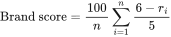
where

- This way we can calculate a common score for all brands mentioned across model responses. The score reflects both how high the brand was ranked and how frequently it was mentioned.
First choice score - adjusted MRR - top-rank indicator
- The first choice score is based on Mean Reciprocal Rank (a common search-engine measure), but adapted to measure the position of a specific brand across repeated ranked responses.
- Each occurrence receives a reciprocal-position score: 100 for 1st, 50 for 2nd, 33.3 for 3rd, 25 for 4th, 20 for 5th, and 0 when the brand is not mentioned. The scores are averaged across all responses.
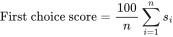
where

- No rank below 1st place gets more than 50, so the score is heavily driven by first places.
Browse other categories
Each one is a single question put to every active AI model, many times over.
- CRM Software#1 HubSpot
- Consulting companies for AI transformation#1 Accenture
- MBA Programs ROI#1 Stanford Graduate School of Business
- AI models for coding#1 Anthropic
- Business Podcasts#1 Acquired
- Business Class airlines#1 Qatar Airways
- EV vehicles#1 Tesla
- Watch brands#1 Omega
See every category with its question and leaders.
Ask your own question of every model
Tell us what to ask and how wide to sample it — we run it and send back the report.