Which form builder would you recommend for a small business?
- Models
- 15
- Answers
- 150
- Brands named
- 16
Which form builder would you recommend for a small business?
15 AI models · 10 answers per model · ranked by score
ordered by brand score: 100 pts for rank 1 → 20 for rank 5 · no mention = 0
- #1Jotform97brand score95first choice12345
- #2Typeform66brand score43first choice
- #3Google Forms54brand score34first choice
- #4Tally23brand score14first choice
- #5Wufoo16brand score11first choice
Show 11 moreShow less
- #6Cognito Forms14brand score8first choice
- gpt-5.6-sol 3.0
- #7Zoho10brand score7first choice
- #8Formstack10brand score8first choice
- #9Paperform4brand score3first choice
- gpt-5 4.0
- #10Microsoft4brand score3first choice
- #11WPForms1brand score0first choice
- #12HubSpot1brand score0first choice
- #13SurveyMonkey1brand score1first choice
- #14Fillout0brand score0first choice
- #15123FormBuilder0brand score0first choice
- #16Formsite0brand score0first choice
Each bar covers the middle half of one model’s answers (Q1–Q3); the line inside it is that model’s median rank for the times it recommended the brand. The badge under a brand says how far apart the models are on it, and “first choice” scores rank 1 far above the rest — a brand can place well overall and still rarely lead an answer.
Swipe left for the full report
Brand by model
Median rank each model gave each brand.
Scroll the table sideways to see every model →
| gpt-6.1-sol | gpt-6-luna | gpt-6-sol | grok-4.7 | gpt-6-astra | gpt-5.6-luna | gpt-5.6-sol | gpt-5.6-terra | gpt-5.5 | gpt-5.4 | gpt-5.2 | gpt-5 | o3 | gpt-4.1 | o1 | |
|---|---|---|---|---|---|---|---|---|---|---|---|---|---|---|---|
| Jotform | 1.0 | 1.0 | 1.0 | 1.0 | 1.0 | 1.0 | 1.0 | 1.0 | 1.0 | 1.0 | 1.0 | 1.0 | 1.0 | 3.0 | 2.0 |
| Typeform | 4.0 | 4.0 | 4.0 | 2.5 | 4.0 | 3.0 | 3.0 | 2.0 | 2.0 | 2.0 | 2.0 | 2.0 | 2.0 | 2.0 | 1.0 |
| Google Forms | 4.0 | 2.0 | 2.0 | 2.5 | 5.0 | 2.5 | 5.0 | 3.0 | 3.0 | 3.0 | 3.0 | 4.5 | 3.0 | 2.0 | 3.0 |
| Tally | 2.0 | 3.0 | 3.0 | 4.0 | 2.0 | — | 2.0 | 2.0 | 4.0 | — | 4.0 | 3.0 | — | — | — |
| Wufoo | — | — | — | 5.0 | 5.0 | 5.0 | 5.0 | 5.0 | 4.5 | 4.0 | 5.0 | 4.5 | 5.0 | 4.0 | 4.0 |
| Cognito Forms | 3.0 | — | — | 4.0 | 3.0 | 4.0 | 3.0 | 4.0 | 3.0 | — | — | 3.5 | 4.0 | — | 5.0 |
| Zoho | 5.0 | 3.0 | 4.0 | — | 5.0 | 4.0 | 4.0 | 4.0 | 4.0 | — | — | 4.0 | — | 5.0 | — |
| Formstack | — | 5.0 | 5.0 | 5.0 | — | 4.5 | — | 5.0 | 5.0 | 5.0 | 4.0 | 5.0 | 4.0 | 5.0 | 5.0 |
| Paperform | 5.0 | 5.0 | 5.0 | — | 5.0 | — | 4.0 | — | — | 5.0 | — | 4.0 | — | — | 4.5 |
| Microsoft | — | 5.0 | 5.0 | 5.0 | — | 5.0 | — | — | — | — | 5.0 | — | — | — | — |
| WPForms | 5.0 | — | — | — | — | — | — | — | — | — | — | — | — | 4.0 | 4.0 |
| HubSpot | — | 3.0 | — | — | — | 4.0 | — | — | — | — | — | — | — | — | — |
| SurveyMonkey | — | 5.0 | — | — | — | — | — | — | — | — | 5.0 | — | — | — | — |
| Fillout | — | — | — | — | 3.0 | — | — | — | — | — | — | — | — | — | — |
| 123FormBuilder | — | — | — | — | — | — | — | — | — | 5.0 | — | — | — | — | — |
| Formsite | — | — | — | — | — | — | — | — | — | — | — | — | 5.0 | — | — |
A dash means that model never named the brand in any of its runs. Deeper blue is better: rank 1 is the brand a model would recommend first.
Where the models disagree
3 of 16 brands split the panel. Each mark is one model's score for the brand, on the same 0–100 scale as the ranking.
- #4Tally0100
gpt-4.1 0 → gpt-6-astra 80 · 5 of 15 never named it
- #3Google Forms0100
gpt-5.6-sol 18 → gpt-4.1 84
- #2Typeform0100
gpt-6-sol 32 → o1 92
- from here down, the models agree
- #6Cognito Forms0100
gpt-4.1 0 → gpt-6.1-sol 54 · 5 of 15 never named it
- #5Wufoo0100
gpt-6-luna 0 → gpt-5.4 48 · 3 of 15 never named it
- #7Zoho0100
gpt-5.2 0 → gpt-6-luna 44 · 5 of 15 never named it
A hollow mark is a model that never named the brand in any of its runs, which scores 0. Agreement is not endorsement — a brand every model ignores equally agrees just as tightly as one they all rank first.
Named, and named first
Across → how frequently the panel names the brand at all.
Up ↑ how often the answers that name it put it first.
- 1Jotform100/91
- 2Typeform100/7
- 3Google Forms91/3
- 4Tally33/0
- 5Wufoo49/0
- 6Cognito Forms29/0
- 7Zoho25/0
- 8Formstack37/0
The horizontal line sits at 20% — the rate a named brand would lead at if the models were picking one of its 5 slots at random. Above it they are choosing it first on purpose. Both figures average across models, so a thinly sampled model counts the same as a heavily sampled one.
What the models actually said
- Models
- 15
- Answers
- 150
Jotform leads with a score of 97 of 100, ranked by 15 of 15 models.
The panel agrees on the winner and disagrees on almost everything below it. Jotform has a brand score of 97.33 and was ranked by all 15 models. Twelve models (the gpt-5 through gpt-6.1 family plus grok-4.7) gave it a perfect 100, and o3 gave it 98. The only dissent comes from the older models: o1 scores it 88 with a median rank of 2, and gpt-4.1 scores it 74 with a median rank of 3. Below Jotform, positions two through five change noticeably depending on which model generation is answering.
Typeform is the clearest generational split. All 15 models name it, but per-model scores run from 32 to 92, with a standard deviation of 18.09. o1 scores it 92 and puts it first in 6 of its 10 runs, and gpt-4.1 and o3 each give it 82. The gpt-5.x models and grok-4.7 mostly hold it at a median rank of 2. The gpt-6 generation pushes it down to a median rank of 4: gpt-6-astra and gpt-6-luna score it 46, gpt-6.1-sol 34 and gpt-6-sol 32. The models describe Typeform's conversational format in nearly the same words. What differs is how much weight they give to its pricing and response limits.
Tally largely takes the slot that the gpt-6 models deny Typeform. It is ranked by only 10 of 15 models and never first, but gpt-6-astra scores it 80, gpt-6.1-sol 64, and gpt-5.6-sol and gpt-6-sol 62 each. Five models never rank it, and gpt-5.2, grok-4.7, gpt-6-luna and gpt-5.5 score it 8 or below.
- 92o10
- 82gpt-4.10
- 82o30
- 80gpt-5.40
- 80gpt-5.54
- 80gpt-5.28
- 68gpt-5.6-luna0
- 70grok-4.78
- 72gpt-5.6-terra20
- 72gpt-528
- 46gpt-6-luna6
- 58gpt-5.6-sol62
- 32gpt-6-sol62
- 34gpt-6.1-sol64
- 46gpt-6-astra80
Typeform ahead on 11 of 15 models
Google Forms splits the panel along a different line, one that does not follow model generation. Per-model scores run from 18 to 84, with a standard deviation of 20.76. gpt-4.1 scores it 84 and is the only model to rank it first, doing so in 4 runs. gpt-6-luna (80) and gpt-6-sol (76) consistently place it second. At the other end, gpt-5.6-sol and gpt-6-astra score it 18 and gpt-5 scores it 22, and these three often leave it out. The models list the same strengths (free, familiar, connected to Sheets) and the same gaps (branding, payments, advanced logic). The split comes from how much those gaps count against it for customer-facing forms.
per-model scores 18–84 of 100 · mean 54 across 15 models
The lower tier is labelled "broad agreement" throughout. The models agree on placement at fourth or fifth and differ mainly on how often they include a brand at all. Even so, there are some model-specific champions:
- Wufoo is kept alive by gpt-5.4 (48), o1 (36) and gpt-4.1 (34), while grok-4.7 scores it 2.
- Cognito Forms draws its support from gpt-6.1-sol (54) and gpt-6-astra (38).
- Zoho depends on gpt-6-luna (44, named in 90% of runs).
- Formstack is strongest with o3 (22) and with gpt-4.1, gpt-5.4 and o1 (20 each).
- Paperform is almost entirely a gpt-5 pick (38, in 7 of 10 runs).
- Microsoft is named consistently only by grok-4.7 (24, 90% coverage).
WPForms, HubSpot and SurveyMonkey each score under 1. Fillout, 123FormBuilder and Formsite appear once each.
A broad pattern emerges from these scores. The older models (o1, gpt-4.1, o3) favour established names: Typeform, Wufoo and Formstack. The gpt-6 generation favours value-oriented or specialist tools: Tally, Cognito Forms and, for some variants, Google Forms.
The recalled sources line up with this pattern, but the connections below are hypotheses, not something the data establishes. The sources are recalled from memory, not verified citations.
- For Typeform, o1, gpt-4.1 and o3 lean on third-party review sites such as G2, Capterra and PCMag. The gpt-6 models cite mostly Typeform's own homepage and pricing page. That fits their emphasis on plan limits, but it does not show the pricing page caused the lower rank.
- Tally's support rests mostly on Tally's own homepage, pricing page and help centre.
- Cognito Forms' capability case among gpt-6-astra and gpt-6.1-sol rests largely on the vendor's own site and pricing page.
The tentative reading is that models drawing more on vendor pricing pages reward low-cost tools. The category-wide anchor is G2's online form builder category (110 recalls), which nearly every model cites, so it cannot by itself explain any split.
What shaped the answers
69 sources across 1811 references, grouped by site from 416 recalled names. The top 5 carry 63% of them.
Sources are what each model recalled as having shaped its view. It does not mean that the sources were actually used in training. Recalled URLs might also be invalid or hallucinated.
g2.com
- ×122/categories/online-form-builder
- ×65/products/jotform/reviews
- ×64/products/typeform/reviews
- ×41named without a URL
- ×38/products/wufoo/reviews
- ×30/products/google-forms/reviews
- ×20/products/formstack-forms/reviews
- ×18/
- ×16/products/cognito-forms/reviews
- ×15/products/zoho-forms/reviews
- ×6/products/formstack/reviews
- ×5G2 Form Builder Software /categories/form-builder
- ×3/categories/survey
- ×3/products/microsoft-forms/reviews
- ×3/products/tally/reviews
- ×2/products/paperform/reviews
- ×1/products/formsite/reviews
- ×1/products/formstack
- ×1/products/formstack/forms/reviews
- ×1/products/google-forms
- ×1/products/hubspot-marketing-hub/reviews
- ×1/products/typeform
Jotform
also named JotForm
Summary
Jotform holds a brand score of 97.33 and a first-choice score of 94.67, and all 15 models rank it. Twelve of them (the gpt-5 through gpt-6.1 family plus grok-4.7) give it a perfect 100 and put it first in every run. o3 follows at 98, with nine first-place runs. Per-model scores span 74 to 100 with a standard deviation of 6.92, which the report labels "models agree." The only real dissent comes from the older models: o1 scores it 88 with a median rank of 2, and gpt-4.1 scores it 74 with a median rank of 3, placing it first in just three runs.
Jotform · 26 points apart on a 0–100 scale
The reasoning is strikingly uniform. Models describe Jotform as the all-around or safest default pick because it pairs an approachable drag-and-drop builder with a large template library, payment collection, conditional logic, approvals and integrations. They also say it lets a business grow from contact forms into intake, orders and workflows without switching tools. The caveats differ by model:
- The gpt-6 and gpt-6.1 variants and gpt-5.6-sol repeatedly tell users to check submission and storage limits on lower plans.
- gpt-6-sol and gpt-4.1 note that the interface can feel busy or cluttered.
- o1, o3 and gpt-4.1 lean more on the generous free plan as a value argument.
Behind these themes, the newer models draw heavily on Jotform's own site and pricing page. The others lean on G2 (especially its Jotform reviews page and its online form builder category), Capterra product pages, Zapier's best-of roundups and PCMag reviews.
“Jotform is usually the safest all-around recommendation for a small business because it is easy to launch, has a broad template library, supports payments, and scales from simple contact forms to more operational workflows.”
“However, its interface can feel cluttered, and some advanced features require higher-tier pricing.”
Per model summary
- gpt-5
- brand score
- 100
- first choice
- 100
- median rank
- 1.0
- present in
- 10/10
Repeatedly calls Jotform the best overall balance of ease, features, and price, emphasizing its template library, built-in payments, approvals, and integrations, with HIPAA and advanced automation available as a business grows.
- gpt-5.2
- brand score
- 100
- first choice
- 100
- median rank
- 1.0
- present in
- 10/10
Describes Jotform as a strong all-around choice that is quick to set up yet offers depth (payments, approvals, file uploads, integrations) and scales from simple contact forms to lightweight workflows without technical work.
- gpt-5.4
- brand score
- 100
- first choice
- 100
- median rank
- 1.0
- present in
- 10/10
Frames Jotform as the safest all-around recommendation because it balances ease of use, broad templates, payments, and workflow features without feeling enterprise-heavy, fitting common SMB needs like lead capture, intake, and registrations.
- gpt-5.5
- brand score
- 100
- first choice
- 100
- median rank
- 1.0
- present in
- 10/10
Names Jotform its top pick for most small businesses, balancing ease of use, a large template library, payments, approvals, and integrations, and citing practical use cases like bookings, order forms, registrations, and intake.
- gpt-5.6-luna
- brand score
- 100
- first choice
- 100
- median rank
- 1.0
- present in
- 10/10
Highlights Jotform's combination of templates, payment collection, integrations, and workflow features without technical expertise, with a free plan for testing and paid tiers for growth, while noting plan limits and pricing can rise.
- gpt-5.6-sol
- brand score
- 100
- first choice
- 100
- median rank
- 1.0
- present in
- 10/10
Calls Jotform the strongest all-around option thanks to its mix of templates, conditional logic, payments, integrations, and workflows, while consistently cautioning that free-plan submission and storage limits may force an upgrade.
- gpt-5.6-terra
- brand score
- 100
- first choice
- 100
- median rank
- 1.0
- present in
- 10/10
Repeatedly calls Jotform the strongest all-around choice, combining an approachable drag-and-drop builder with templates, payments, e-signatures, approvals, and integrations so a business can expand use cases without switching platforms.
- gpt-6-astra
- brand score
- 100
- first choice
- 100
- median rank
- 1.0
- present in
- 10/10
Nearly verbatim calls Jotform its best all-around recommendation for its approachable builder, extensive templates, payments, and integrations covering inquiries to orders, while advising users to check submission and storage limits.
- gpt-6-luna
- brand score
- 100
- first choice
- 100
- median rank
- 1.0
- present in
- 10/10
Presents Jotform as a strong all-around choice with broad templates, payment collection, and integrations that grow with a business, routinely noting that its free plan is easy to start with but usage limits may require a paid plan.
- gpt-6-sol
- brand score
- 100
- first choice
- 100
- median rank
- 1.0
- present in
- 10/10
Recommends Jotform as a top pick for businesses needing more than simple surveys (payments, registrations, approvals), while often noting its breadth can feel busy or complex and that free-plan limits should be checked.
- gpt-6.1-sol
- brand score
- 100
- first choice
- 100
- median rank
- 1.0
- present in
- 10/10
Consistently names Jotform its best all-around recommendation for combining an approachable builder with templates, integrations, payments, and conditional logic, with a recurring caveat about submission and storage limits on plans.
- grok-4.7
- brand score
- 100
- first choice
- 100
- median rank
- 1.0
- present in
- 10/10
Positions Jotform as the strongest default for small businesses, pairing a drag-and-drop builder with payments, conditional logic, and a large template library at approachable pricing, plus integrations like Google Sheets, Stripe, and PayPal.
- o3
- brand score
- 98
- first choice
- 95
- median rank
- 1.0
- present in
- 10/10
Emphasizes Jotform's generous free tier, hundreds of templates, and beginner-friendly drag-and-drop builder, plus payment, CRM, and HIPAA/automation features that let a business scale without outgrowing the platform.
- o1
- brand score
- 88
- first choice
- 70
- median rank
- 2.0
- present in
- 10/10
Focuses on Jotform's user-friendly drag-and-drop builder, wide template selection, and integrations, frequently mentioning a generous free plan suited to budget-conscious small businesses.
- gpt-4.1
- brand score
- 74
- first choice
- 55
- median rank
- 3.0
- present in
- 10/10
Consistently cites Jotform's generous free plan, large template library, and integrations as good value for small businesses, while often noting a cluttered interface and advanced features locked behind paid tiers.
Sources per model
Each model’s own references for this brand, grouped by site. Tile area is that site’s share of the model’s references; tap one for the pages behind it.
jotform.com
- ×9/pricing
- ×5Jotform /
- ×2Jotform /features
- ×1Jotform Templates /form-templates
jotform.com
- ×9/
- ×2Jotform Pricing /pricing
- ×1Jotform Features /features
- ×1Jotform Integrations /integrations
capterra.com
capterra.com
Sources are what each model recalled as having shaped its view. It does not mean that the sources were actually used in training. Recalled URLs might also be invalid or hallucinated.
Typeform
Summary
Typeform is named by all 15 models, which gives it a brand score of 66.27 and a first choice score of 43.32. Reach is universal, but its placement varies widely. Per-model brand scores run from 32 to 92, with a standard deviation of 18.09, which the report labels "models split." The enthusiasm sits mostly with older models. o1 scores it 92 and puts it first in 6 of its 10 runs. gpt-4.1 and o3 each give it 82. The gpt-5.x family and grok-4.7 cluster around a median rank of 2, often explicitly placing it just behind Jotform. The gpt-6 generation pushes it down to a median rank of 4: gpt-6-astra and gpt-6-luna score it 46, gpt-6.1-sol 34 and gpt-6-sol 32.
per-model scores 32–92 of 100 · mean 66 across 15 models
The praise is nearly identical across the panel. Models credit its polished, conversational, one-question-at-a-time format with lifting completion rates and brand impression for lead capture, surveys and feedback. The disagreement comes from how much weight each model gives to pricing and response limits. Higher-ranking models treat cost as a footnote. Lower-ranking ones frame it as the reason Typeform is not a default for cost-conscious or operational use, ranking it beneath Jotform or Tally. The recalled sources follow the same divide. o1, gpt-4.1 and o3 lean on third-party review sites such as G2's Typeform reviews page, Capterra, PCMag and TechRadar. The gpt-6 models cite almost exclusively Typeform's own homepage and its pricing page, which fits their focus on plan limits and cost.
“It stands out for its conversational interface, which can help boost response rates.”
“Its pricing and usage limits make it harder to recommend as the default choice for a cost-conscious small business.”
Per model summary
- o1
- brand score
- 92
- first choice
- 80
- median rank
- 1.0
- present in
- 10/10
Mostly emphasizes Typeform's sleek, engaging, conversational interface and customization that boost response rates and brand image, with only occasional mention of higher pricing.
- gpt-4.1
- brand score
- 82
- first choice
- 62
- median rank
- 2.0
- present in
- 10/10
Consistently highlights Typeform's visually appealing, user-friendly, conversational forms that boost engagement and response rates, and often notes that pricing and free-plan limits may be restrictive for some small businesses.
- gpt-5
- brand score
- 72
- first choice
- 43
- median rank
- 2.0
- present in
- 10/10
Repeatedly describes polished, conversational UX that boosts completion rates for lead capture and customer-facing surveys, and says pricing and response caps can add up as volume grows.
- gpt-5.2
- brand score
- 80
- first choice
- 50
- median rank
- 2.0
- present in
- 10/10
Frames Typeform as best when completion rates and a premium conversational experience matter for leads and customer research, while noting it gets pricier at scale and is less back-office oriented.
- gpt-5.4
- brand score
- 80
- first choice
- 50
- median rank
- 2.0
- present in
- 10/10
Consistently praises the conversational design and higher completion rates for customer-facing forms, but ranks it slightly below Jotform because of higher pricing and less operational utility.
- gpt-5.5
- brand score
- 80
- first choice
- 50
- median rank
- 2.0
- present in
- 10/10
Repeatedly calls Typeform excellent when presentation and completion rates matter for surveys, quizzes and lead capture, but ranks it below Jotform because of cost and weaker fit for operational forms.
- gpt-5.6-terra
- brand score
- 72
- first choice
- 43
- median rank
- 2.0
- present in
- 10/10
Repeatedly describes a polished, conversational respondent experience for lead forms, quizzes and feedback, while noting it is less economical than Jotform at higher volumes or for operational needs.
- o3
- brand score
- 82
- first choice
- 55
- median rank
- 2.0
- present in
- 10/10
Consistently cites the one-question-at-a-time interface driving higher completion rates and polished branding, but places Typeform just behind Jotform because of steeper pricing and response limits.
- grok-4.7
- brand score
- 70
- first choice
- 42
- median rank
- 2.5
- present in
- 10/10
Focuses on the one-question-at-a-time conversational format that improves completion and brand impression for customer-facing forms, with paid plans getting expensive quickly as responses grow.
- gpt-5.6-luna
- brand score
- 68
- first choice
- 40
- median rank
- 3.0
- present in
- 10/10
Emphasizes a polished, conversational experience and branding suited to lead generation and customer research, offset by pricing and response limits that are less appealing for high-volume businesses.
- gpt-5.6-sol
- brand score
- 58
- first choice
- 33
- median rank
- 3.0
- present in
- 10/10
Consistently credits polished conversational forms for surveys and lead capture, but says pricing and response limits make it harder to justify for volume- or value-focused small businesses, ranking it below Jotform or Tally.
- gpt-6-astra
- brand score
- 46
- first choice
- 28
- median rank
- 4.0
- present in
- 10/10
Consistently praises polished, conversational forms for lead generation and feedback, but ranks Typeform lower, often fourth or below Jotform and Tally, because of response limits and paid-plan costs.
- gpt-6-luna
- brand score
- 46
- first choice
- 28
- median rank
- 4.0
- present in
- 10/10
Repeatedly calls Typeform a good fit when a polished, conversational experience matters, but cautions that its cost and plan limits may not be justified for routine or basic data collection.
- gpt-6-sol
- brand score
- 32
- first choice
- 23
- median rank
- 4.0
- present in
- 10/10
Consistently notes Typeform suits forms where respondent experience and presentation matter, but says pricing and usage limits make it hard to recommend as a default for cost-conscious small businesses.
- gpt-6.1-sol
- brand score
- 34
- first choice
- 24
- median rank
- 4.0
- present in
- 10/10
Repeatedly highlights polished, conversational forms for feedback and lead generation, but ranks Typeform lower, often fourth or fifth, because response allowances and paid-plan costs need scrutiny when presentation isn't the priority.
Sources per model
Each model’s own references for this brand, grouped by site. Tile area is that site’s share of the model’s references; tap one for the pages behind it.
g2.com
- ×3named without a URL
- ×2/
- ×2/products/typeform/reviews
- ×1/categories/online-form-builder
- ×1/products/typeform
Sources are what each model recalled as having shaped its view. It does not mean that the sources were actually used in training. Recalled URLs might also be invalid or hallucinated.
Google Forms
also named Google
Summary
Google Forms is named by all 15 models but lands in the middle on strength, with a brand score of 53.6 and a first choice score of 33.67. Per-model brand scores run from 18 to 84 with a standard deviation of 20.76, which the report labels as models split. gpt-4.1 is the outlier at the top: it scores the brand 84 and is the only model to put it first, doing so in 4 of its runs. gpt-6-luna (80) and gpt-6-sol (76) also rank it highly, but consistently in second place. At the other end, gpt-5.6-sol and gpt-6-astra each score it 18 and gpt-5 scores it 22. These three name it in fewer runs and usually place it last.
per-model scores 18–84 of 100 · mean 54 across 15 models
The disagreement is about where to place the tool, not what it is. Nearly every model describes it the same way: free or low-cost, familiar, quick to share, and feeding responses into Google Sheets, which makes it a natural fit for teams already on Google Workspace. The models apply the same limitations almost word for word: branding, design control, native payments, and advanced logic or workflows. How much weight a model gives those gaps for customer-facing forms largely determines whether it ranks Google Forms second or fifth. Several models frame it as a starter tool that growing businesses outgrow, and gpt-6-sol repeatedly sets it below Jotform. The recalled sources behind this picture are mostly Google's own pages, especially the google.com/forms/about page and assorted Google Workspace and help-center URLs. Third-party sources add to these, led by G2's Google Forms reviews page alongside Zapier roundups, PCMag, TechRadar and Capterra. o3 also leans on "personal experience."
“The trade-off is limited design customization and lack of native payments or advanced logic, so businesses often outgrow it as their needs expand.”
“It ranks last here because its limited branding flexibility and lack of native payment collection make it less versatile for customer-facing business workflows.”
Per model summary
- gpt-4.1
- brand score
- 84
- first choice
- 67
- median rank
- 2.0
- present in
- 10/10
Describes Google Forms as free, very easy to use, and well integrated with Google Workspace, suiting budget-conscious small businesses with basic needs. Notes limited customization and advanced features as the main drawback.
- gpt-6-luna
- brand score
- 80
- first choice
- 50
- median rank
- 2.0
- present in
- 10/10
Describes it as an easy, low-cost choice for simple surveys, registrations, and feedback forms, particularly for Google Workspace users. Says it is less suited to businesses needing extensive branding or advanced workflows.
- gpt-6-sol
- brand score
- 76
- first choice
- 47
- median rank
- 2.0
- present in
- 10/10
Presents it as an easy option for straightforward surveys and internal requests within Google Workspace. Repeatedly ranks it below Jotform because of limited design, branding, payments, and complex workflows.
- gpt-5.6-luna
- brand score
- 68
- first choice
- 41
- median rank
- 2.5
- present in
- 10/10
Frames it as a low-cost, familiar tool for simple surveys, registrations, and internal data collection with natural Sheets integration. Notes it has fewer design, branding, payment, and automation features than dedicated platforms.
- grok-4.7
- brand score
- 70
- first choice
- 42
- median rank
- 2.5
- present in
- 10/10
Calls it the practical no-cost default for Workspace users, with responses going straight into Sheets, suited to sign-ups, RSVPs, and internal requests. Describes it as a starter tool that is limited on branding, payments, and advanced logic.
- gpt-5.2
- brand score
- 60
- first choice
- 33
- median rank
- 3.0
- present in
- 10/10
Calls it hard to beat on cost and simplicity, with easy sharing and Google Sheets reporting. The recurring tradeoff is limited branding, logic, payments, and workflow features compared with dedicated builders.
- gpt-5.4
- brand score
- 48
- first choice
- 29
- median rank
- 3.0
- present in
- 10/10
Calls it an easy recommendation for budget-conscious teams on Google Workspace that need basic surveys and intake. Usually ranks it mid-pack or low because branding, payments, and advanced workflows are weaker than in specialized builders.
- gpt-5.5
- brand score
- 50
- first choice
- 28
- median rank
- 3.0
- present in
- 9/10
Treats it as a free, simple, reliable option feeding into spreadsheets, especially for Workspace users. Consistently ranks it lower due to limited branding, design, payments, and advanced workflows.
- gpt-5.6-terra
- brand score
- 60
- first choice
- 35
- median rank
- 3.0
- present in
- 10/10
Positions it as a low-cost option for internal requests, RSVPs, and basic intake, particularly for teams already on Google Workspace. Says presentation, payments, branding, and advanced workflows are comparatively limited.
- o1
- brand score
- 48
- first choice
- 27
- median rank
- 3.0
- present in
- 8/10
Emphasizes that it is free, straightforward, and integrates seamlessly with Google services, which suits basic data collection. Notes it lacks advanced customization features.
- o3
- brand score
- 60
- first choice
- 33
- median rank
- 3.0
- present in
- 10/10
Stresses that it is completely free, easy to learn, and tightly integrated with Google Workspace and Sheets. Points to limited design, logic, and native payments as reasons growing businesses often outgrow it.
- gpt-6.1-sol
- brand score
- 42
- first choice
- 28
- median rank
- 4.0
- present in
- 10/10
Calls it a practical starting point for simple surveys and internal data collection for Google Sheets users. Says limited branding and no native payment collection make it less versatile than higher-ranked builders.
- gpt-5
- brand score
- 22
- first choice
- 15
- median rank
- 4.5
- present in
- 6/10
Presents it as free, fast, and reliable for internal surveys and simple data capture with Sheets syncing. Says limited branding, payments, and advanced logic make it weak for polished customer-facing forms.
- gpt-5.6-sol
- brand score
- 18
- first choice
- 17
- median rank
- 5.0
- present in
- 8/10
Describes it as free and familiar, adequate for simple surveys, registrations, and internal data collection. Frequently ranks it last because of limited branding, payment support, workflows, and customer-facing polish.
- gpt-6-astra
- brand score
- 18
- first choice
- 14
- median rank
- 5.0
- present in
- 6/10
Calls it a practical, low-cost starting point for basic surveys and internal requests, especially for Google Sheets users. Ranks it low because of limited branding and the lack of native payment collection for customer-facing use.
Sources per model
Each model’s own references for this brand, grouped by site. Tile area is that site’s share of the model’s references; tap one for the pages behind it.
workspace.google.com
- ×5/products/forms
- ×2Google Workspace Marketplace /marketplace
- ×1Google Workspace Pricing /pricing.html
Sources are what each model recalled as having shaped its view. It does not mean that the sources were actually used in training. Recalled URLs might also be invalid or hallucinated.
Tally
Summary
Tally holds a mid-table position with a brand score of 22.8 and a first choice score of 14.02. It was ranked by 10 of the 15 models, and none of them put it first in any run. Its first choice credit comes entirely from second- and lower-place finishes. The panel is sharply divided. Per-model brand scores span 0 to 80, with a standard deviation of 27.99, which the report labels "models split." The strongest support comes from gpt-6-astra (80, ranked in all 10 runs), gpt-6.1-sol (64), gpt-5.6-sol (62) and gpt-6-sol (62), each typically placing Tally second or third. gpt-5 (28) and gpt-5.6-terra (20) name it less often. gpt-5.2, grok-4.7, gpt-6-luna and gpt-5.5 mention it only occasionally, with scores of 8 or below, and five models do not rank it at all.
per-model scores 0–80 of 100 · mean 23 across 15 models
The models that do rank Tally describe it in remarkably similar terms. They call it a budget-conscious or value pick, built on a generous free tier, with features such as conditional logic, payments and unlimited forms under fair-use terms, and a fast, document-like or Notion-style editor. The recurring ceiling is Jotform. Nearly every model places Tally just behind it, citing Jotform's broader template library and integration ecosystem. Several models, including gpt-5.2, gpt-5.5 and gpt-6-sol, also flag thinner support for advanced workflows, compliance or governance. The recalled sources behind the pricing and feature claims are mostly Tally's own pages: its homepage, pricing page and help center. Product Hunt, G2, Zapier's form-builder roundups, Capterra and Reddit r/nocode appear in smaller numbers, mostly alongside the "newer, smaller ecosystem" framing.
“I rank it just behind Jotform because its simpler ecosystem may be less suitable for businesses needing extensive templates and specialized workflows.”
“Tally is appealing for very small businesses because it is clean, fast, and generous at low cost.”
Per model summary
- gpt-5.6-sol
- brand score
- 62
- first choice
- 38
- median rank
- 2.0
- present in
- 8/10
Repeatedly frames Tally as ideal for budget-conscious businesses because of a generous free offering and a fast, document-like editor. It consistently ranks Tally below Jotform for its less extensive templates, integrations, and advanced workflow features.
- gpt-5.6-terra
- brand score
- 20
- first choice
- 13
- median rank
- 2.0
- present in
- 3/10
Highlights Tally's clean, modern, document-like editor and capable free tier as a value option for budget-conscious teams. It notes a smaller ecosystem and less enterprise-style breadth than Jotform and other established tools.
- gpt-6-astra
- brand score
- 80
- first choice
- 50
- median rank
- 2.0
- present in
- 10/10
Consistently calls Tally its budget-friendly or value pick, citing a document-style editor and generous free features such as conditional logic and unlimited forms under fair-use terms. It places Tally just behind Jotform because of Jotform's broader templates and integrations.
- gpt-6.1-sol
- brand score
- 64
- first choice
- 40
- median rank
- 2.0
- present in
- 8/10
Frames Tally as especially attractive for budget-conscious businesses, citing a generous free offering that includes conditional logic and payments, plus an easy document-style editor. It consistently ranks Tally below Jotform for Jotform's broader template and integration ecosystem.
- gpt-5
- brand score
- 28
- first choice
- 18
- median rank
- 3.0
- present in
- 5/10
Describes Tally as outstanding value for lean teams, citing a generous free plan with unlimited forms/responses and a simple Notion-like editor. It consistently notes the trade-off of fewer native integrations and advanced features than larger platforms.
- gpt-6-luna
- brand score
- 6
- first choice
- 3
- median rank
- 3.0
- present in
- 1/10
Sees Tally as appealing for clean forms with a low learning curve and a generous free offering. It notes it may be less complete than Jotform for broad integrations or advanced workflows.
- gpt-6-sol
- brand score
- 62
- first choice
- 36
- median rank
- 3.0
- present in
- 10/10
Repeatedly describes Tally as good for building clean, straightforward forms quickly with little setup and low cost. It ranks Tally below Jotform or Google and advises checking its integrations and workflow coverage before committing.
- gpt-5.2
- brand score
- 8
- first choice
- 5
- median rank
- 4.0
- present in
- 2/10
Emphasizes Tally's unusually generous free tier and clean, modern builder suited to straightforward forms and light automation. It notes that, as a newer and simpler platform, it may lack deep integrations, governance, and complex workflow support.
- gpt-5.5
- brand score
- 4
- first choice
- 3
- median rank
- 4.0
- present in
- 1/10
Presents Tally as clean, fast, and generous at low cost for very small businesses. It ranks it fourth because it is less established and may not cover advanced integration, compliance, or workflow needs.
- grok-4.7
- brand score
- 8
- first choice
- 5
- median rank
- 4.0
- present in
- 2/10
Emphasizes Tally's generous free plan and document-like editor that suits non-technical small teams, along with adequate support for logic, embeds, and payments. It ranks Tally just behind established options because of a thinner template and integration ecosystem.
Sources per model
Each model’s own references for this brand, grouped by site. Tile area is that site’s share of the model’s references; tap one for the pages behind it.
tally.so
- ×10/
- ×6Tally Pricing /pricing
- ×3Tally Help Center /help
- ×1Tally Pricing /help/pricing
Sources are what each model recalled as having shaped its view. It does not mean that the sources were actually used in training. Recalled URLs might also be invalid or hallucinated.
Wufoo
also named WuFoo
Summary
Wufoo sits low in this panel. Its brand score is 15.6 of 100 and its first choice score is 11.31. Twelve of the 15 models rank it, but none ever puts it first. Its median ranks fall between 4 and 5, so the first choice score reflects partial credit for lower placements rather than any lead positions. Per-model brand scores span 0–48, with a standard deviation of 14.83, which the report labels "broad agreement." The models agree on Wufoo's placement near the bottom of their lists and differ mainly on how often they include it at all. gpt-5.4 names it in every run and gives it the highest score (48). o1 (36) and gpt-4.1 (34) also include it in nearly every run. By contrast, grok-4.7 (2), gpt-5.6-sol (4) and gpt-6-astra (4) mention it only occasionally.
per-model scores 0–48 of 100 · mean 16 across 15 models
The reasoning is remarkably uniform. Wufoo is described as long-established, reliable and straightforward for basic contact, registration and payment forms. Nearly every model then qualifies this by calling it dated or less modern in interface, design flexibility, automation and integrations. Several, notably o3 and gpt-4.1, add that its pricing and value lag newer rivals. o3 is the harshest, repeatedly calling Wufoo a stagnant pioneer and the least compelling option. The recalled sources behind these views are concentrated in a few places:
- G2: the G2 Wufoo reviews page is the most frequent citation for o3, gpt-4.1, gpt-5.4, gpt-5.6-luna and gpt-5.6-terra.
- Wufoo's own site and pricing page: these lead for gpt-5.6-terra and gpt-5.2.
- Capterra: a scatter of Capterra product pages appears across many models.
- PCMag: reviews from PCMag appear mostly under gpt-4.1.
“Wufoo pioneered easy web form creation, but its interface feels dated and its feature set has stagnated relative to competitors.”
“I place it in the middle because it has a long-standing reputation and solid basics, but it feels less modern and less top-of-mind than some leading alternatives.”
Per model summary
- gpt-4.1
- brand score
- 34
- first choice
- 22
- median rank
- 4.0
- present in
- 9/10
Describes Wufoo as long-established and reliable with easy drag-and-drop building, but consistently notes its dated interface and pricing that is less competitive than newer alternatives.
- gpt-5.4
- brand score
- 48
- first choice
- 28
- median rank
- 4.0
- present in
- 10/10
Consistently treats Wufoo as a recognizable, approachable, long-standing option for simple use cases, but ranks it mid-to-low because it feels less modern and less top-of-mind than newer competitors.
- o1
- brand score
- 36
- first choice
- 23
- median rank
- 4.0
- present in
- 9/10
Emphasizes Wufoo's user-friendly interface, ease of use, and reliability for simple forms, with caveats about limited advanced features, lower-tier restrictions, and a less modern feel.
- gpt-5
- brand score
- 6
- first choice
- 5
- median rank
- 4.5
- present in
- 2/10
Frames Wufoo as simple and reliable for basic forms, but says its dated UI and limited depth in customization, logic, and integrations lag newer competitors.
- gpt-5.5
- brand score
- 18
- first choice
- 14
- median rank
- 4.5
- present in
- 6/10
Describes Wufoo as dependable and straightforward for basic small-business forms and payments, but ranks it lower because it feels less modern and flexible than rivals such as Jotform and Typeform.
- gpt-5.2
- brand score
- 20
- first choice
- 16
- median rank
- 5.0
- present in
- 7/10
Repeatedly calls Wufoo straightforward, stable, and dependable for basic forms and payments, while saying it feels less modern in design, UX, and automation than newer leaders and offers weaker value.
- gpt-5.6-luna
- brand score
- 12
- first choice
- 12
- median rank
- 5.0
- present in
- 6/10
Calls Wufoo capable for conventional forms with integrations, but says its interface and product experience feel less modern, so it is mainly worth choosing for existing familiarity or specific integrations.
- gpt-5.6-sol
- brand score
- 4
- first choice
- 4
- median rank
- 5.0
- present in
- 2/10
Describes Wufoo as dependable and easy to learn, with templates, reports, and integrations, but notes its design and flexibility feel less modern than higher-ranked options.
- gpt-5.6-terra
- brand score
- 24
- first choice
- 20
- median rank
- 5.0
- present in
- 9/10
Repeatedly frames Wufoo as a capable, established builder for conventional forms, reporting, and payments, but sees its less modern interface and product momentum as making it a weak default for new small-business setups.
- gpt-6-astra
- brand score
- 4
- first choice
- 4
- median rank
- 5.0
- present in
- 2/10
Sees Wufoo as practical for straightforward contact, registration, and payment forms, but ranks it last because its traditional editing and design experience is less appealing than the alternatives.
- grok-4.7
- brand score
- 2
- first choice
- 2
- median rank
- 5.0
- present in
- 1/10
Notes that Wufoo, now part of SurveyMonkey, still covers basic forms and payments but has seen less modern innovation, and is recommended mainly for teams already in the SurveyMonkey ecosystem.
- o3
- brand score
- 26
- first choice
- 22
- median rank
- 5.0
- present in
- 10/10
Consistently calls Wufoo a pioneer of easy web forms whose dated interface, stagnant features, limited integrations, and weak price-to-value now make it the least compelling option.
Sources per model
Each model’s own references for this brand, grouped by site. Tile area is that site’s share of the model’s references; tap one for the pages behind it.
no URL recalled
- ×1named without a URL
capterra.com
capterra.com
- ×1/p/105494/Wufoo
- ×1/p/108839/Wufoo
- ×1/p/117932/Wufoo
- ×1/p/44383/Wufoo
- ×1/p/76621/Wufoo
- ×1named without a URL
no URL recalled
- ×5named without a URL
Sources are what each model recalled as having shaped its view. It does not mean that the sources were actually used in training. Recalled URLs might also be invalid or hallucinated.
How this was measured
The question
- Unaided brand recommendation question: “Which form builder would you recommend for a small business?”
- The prompt asks each model to return exactly 5 brands, ranked 1 to 5, and for each one a reason for the recommendation and the sources that informed it.
Sampling
- Models are not deterministic, so the question is asked over and over — 10 answers per model
- Spellings of the same brand are normalized to the most commonly used form before counting
Measures of Position: Median and Quartiles
- Median value indicates that in 50% of answers the brand held this position or higher.
- Quartiles help visualize the spread of rankings per brand. Q1 indicates that 25% of answers had this rank or higher. Q3 means that 75% of answers ranked the brand as X or better.
- Medians and quartiles are computed only from answers where the brand was present.
Coverage
- Count of answers in which the given brand was named, as a percentage.
Brand score - Normalized Borda score
- The brand score is calculated using a normalized Borda score. Borda count is a voting method: each ballot awards points by position instead of naming one winner. Our ranking responses from the LLM are always fixed to 5 answers, so we assign 100 points for rank 1, then 80, 60, 40, 20 — and 0 if the brand is missing.
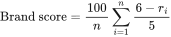
where

- This way we can calculate a common score for all brands mentioned across model responses. The score reflects both how high the brand was ranked and how frequently it was mentioned.
First choice score - adjusted MRR - top-rank indicator
- The first choice score is based on Mean Reciprocal Rank (a common search-engine measure), but adapted to measure the position of a specific brand across repeated ranked responses.
- Each occurrence receives a reciprocal-position score: 100 for 1st, 50 for 2nd, 33.3 for 3rd, 25 for 4th, 20 for 5th, and 0 when the brand is not mentioned. The scores are averaged across all responses.
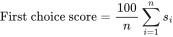
where

- No rank below 1st place gets more than 50, so the score is heavily driven by first places.
Browse other categories
Each one is a single question put to every active AI model, many times over.
Or scroll for more
- Running shoes for marathon#1 NikeRunning shoes for marathonWhat brand of running shoes would you recommend for a marathon#1Nike84#2ASICS81#3Saucony468 ranked
- CRM Software#1 HubSpotCRM SoftwareWhat CRM software would you recommend?#1HubSpot95#2Salesforce85#3Zoho539 ranked
- Consulting companies for AI transformation#1 McKinsey & CompanyConsulting companies for AI transformationWhich consulting firm should a Fortune 500 company hire for an AI transformation?#1McKinsey & Company87#2Accenture78#3Boston Consulting Group638 ranked
- MBA Programs ROI#1 Stanford Graduate School of BusinessMBA Programs ROIWhich MBA program gives you the best return on investment?#1Stanford Graduate School of Business66#2Wharton46#3Harvard Business School4439 ranked
- AI models for coding#1 AnthropicAI models for codingWhich AI model would you recommend for coding?#1Anthropic90#2OpenAI74#3Google5215 ranked
- Business Podcasts#1 How I Built ThisBusiness PodcastsWhich business podcast would you recommend?#1How I Built This77#2Acquired54#3Masters of Scale4131 ranked
- Business Class airlines#1 Qatar AirwaysBusiness Class airlinesWhich airline would you recommend for business-class travel?#1Qatar Airways87#2Singapore Airlines84#3Emirates4216 ranked
- EV vehicles#1 TeslaEV vehiclesWhich EV brand would you recommend?#1Tesla91#2Hyundai74#3Kia3514 ranked
- Watch brands#1 OmegaWatch brandsWhich watch brand would you wear on a first date?#1Omega79#2Cartier64#3Seiko4432 ranked
- Neobanks uk#1 Starling BankNeobanks ukWhat neobank would you recommend for a UK startup?#1Starling Bank87#2Revolut69#3Tide6018 ranked
- No Code Platforms#1 AirtableNo Code PlatformsWhat are the best no-code platforms for a company to build internal workflows and apps without developers?#1Airtable82#2Microsoft Power Apps54#3Zapier3923 ranked
- AI Brand Visibility Tools#1 ProfoundAI Brand Visibility ToolsWhat AI brand visibility tool would you recommend?#1Profound73#2Peec AI48#3Semrush4031 ranked
- Airtable agencies#1 GAP ConsultingAirtable agenciesWhich Airtable agency would you recommend?#1GAP Consulting43#2Openside33#3On2Air31153 ranked
- Review response Hospitality#1 TrustYouReview response HospitalityWhat review response platform would you recommend for a hotel?#1TrustYou81#2Revinate67#3ReviewPro6223 ranked
Ask your own question of every model
Tell us what to ask and how wide to sample it — we run it and send back the report.